
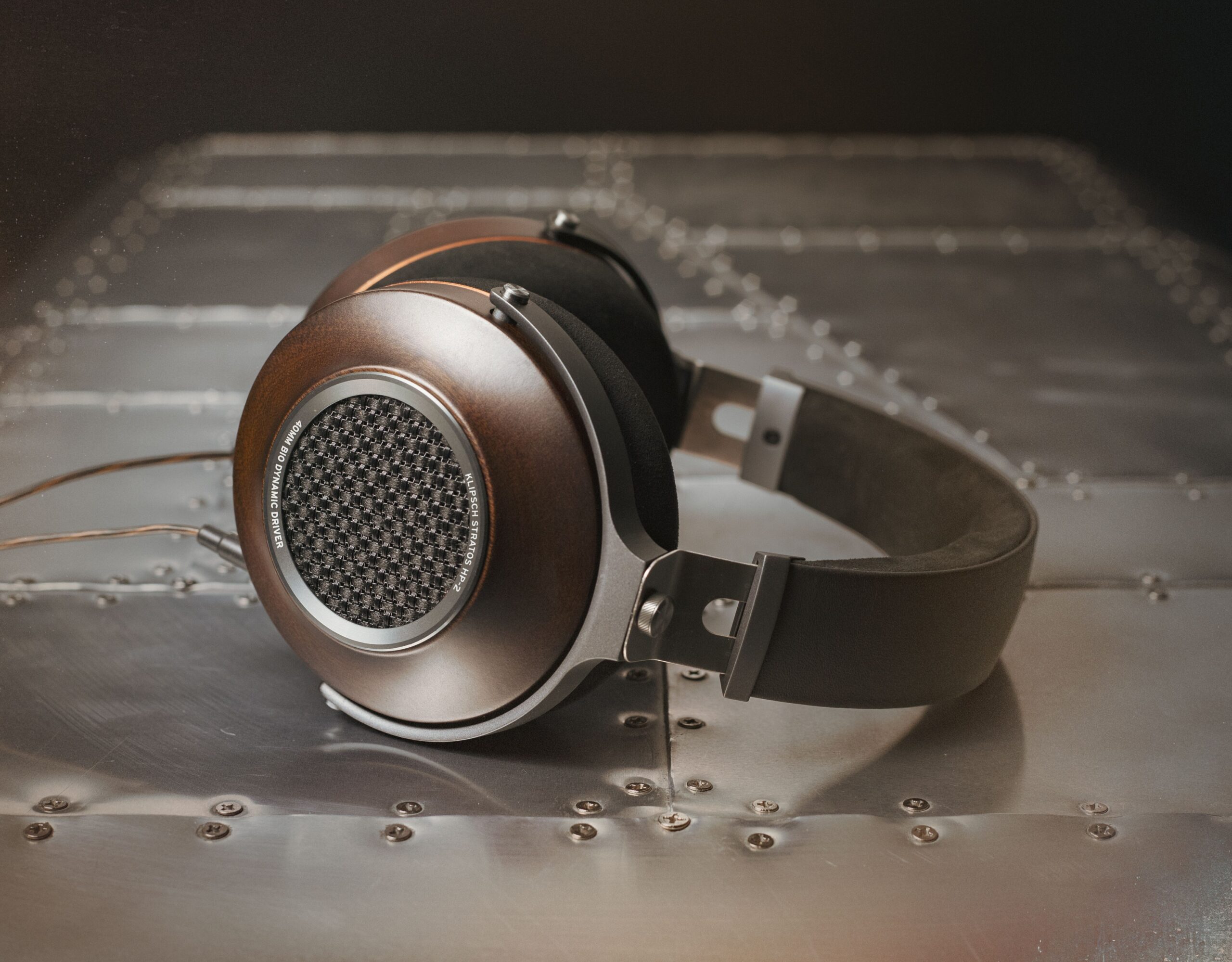
Klipsch makes a bold return to wired audiophile headphones with a coaxial driver design, while sister brand Onkyo unveils a fully balanced, dual-SABRE desktop powerhouse built to drive them.
If you’ve been waiting for two of hi-fi’s most recognizable heritage brands to get serious about desktop personal audio again, your wait is officially over. Both Klipsch and Onkyo are celebrating 80 years in the audio game, and rather than resting on their laurels, they’re marking the milestone with a coordinated push into the personal hi-fi space.
Having made its world premiere at CanJam Dallas (November 14–15, 2026), Klipsch is returning to the premium over-ear arena with the wired Stratos Series—consisting of the closed-back Stratos HP-2 ($999.99) and the semi-open Stratos HP-3 ($1,199.99). Right alongside them, Onkyo is stepping into the desktop arena with the HA-70 ($649.99), a compact, fully balanced headphone amplifier and DAC engineered to anchor a serious personal listening rig.
On paper, this looks like a genuine statement of intent from both camps—blending classic American and Japanese audio heritage with modern enthusiast tech. Let’s break down what both brands are bringing to the table.

Klipsch Stratos HP-2 & HP-3: Heritage Aesthetics Meet Coaxial Driver Tech
Klipsch fans who remember the brand’s cult-favorite Heritage HP-3 headphones will immediately dig the visual DNA here. The new Stratos Series leans hard into that nostalgic-yet-modern luxury vibe, pairing real stained sapele wood earcups with machined aluminum yokes, copper-ring accents, and Klipsch’s signature Heritage Twitchell grille cloth.
What really grabs my attention, though, is what’s happening inside the cups. Instead of a standard single dynamic driver, Klipsch went with an innovative two-way coaxial driver array in both models, sticking to founder Paul W. Klipsch’s core philosophy of high efficiency and low distortion:
- Stratos HP-3 (Semi-Open Back): Pairs a 50mm bio-cellulose mid/bass driver with a 10mm dynamic tweeter, aimed at delivering warm, punchy bass and crisp, sparkly highs with a more open presentation.
- Stratos HP-2 (Closed-Back): Combines a 40mm bio-cellulose mid/bass driver with a 10mm dynamic tweeter, tuned for deep bass and strong passive noise isolation suited for studio monitoring or quieter shared spaces.
Comfort looks like it was a real priority, too. Both models feature a protein-leather headband lined with open-cell foam and a dedicated center cutout to eliminate crown hotspots during marathon listening sessions. The earpads are wrapped in ultrasoft microsuede and attach magnetically—a huge quality-of-life touch when it’s time to swap pads.
Even better, Klipsch didn’t skimp on what’s in the box. Both models ship in a rich Auburn finish with two detachable braided nylon cables—a 2.5m (3.5mm unbalanced) cable and a 1.37m (4.4mm balanced) cable—plus a 3.5mm to 1/4-inch adapter.

Onkyo HA-70: A Fully Balanced Desktop Centerpiece
If you’re going to drop a grand on a pair of wired audiophile headphones, you want a desktop front end that does them justice—and that’s clearly where the Onkyo HA-70 comes in.
Housed in a sleek, precision-engineered aluminum chassis measuring just 180 × 141 × 46 mm, the HA-70 won’t eat up your entire desk, yet Onkyo packed serious two-channel engineering inside. The standout features include:
- Fully Balanced Circuit Architecture: Runs a pure, fully balanced signal path from the DAC all the way to the headphone output, with dedicated DAC and amplifier stages for each channel to maximize separation and keep the noise floor low.
- Dual ESS SABRE DACs: Uses a pair of ESS ES9039Q2M chips paired with custom analog circuitry for clean, natural, and detailed playback.
- High-Res Digital Platform: Built around an XMOS XU316 USB interface, supporting PCM up to 768 kHz and DSD256 (DoP).
- Three-Stage Gain Control: Gives you Ultra Low Gain for sensitive IEMs, Low Gain for easy-to-drive headphones, and High Gain for power-hungry reference cans up to 600 ohms.
- Flexible Desktop I/O: Includes USB-C, optical, and coaxial digital inputs, plus RCA and balanced XLR outputs so it can pull double duty as a desktop DAC/preamp in a larger hi-fi rig.
The Takeaway: Who Is This Setup For?
What I dig most about this double announcement is how practical it is for real-world music lovers. With low impedance (24Ω on the HP-3, 32Ω on the HP-2) and high sensitivity (100–102 dB), Klipsch clearly designed the Stratos headphones to sound great right out of a smartphone or portable dongle—while still having the headroom to scale up when plugged into a balanced desktop rig like the HA-70.
A couple of things to keep in mind before you pull out your wallet:
- Staggered Launch Dates: If you want the full Klipsch + Onkyo desktop stack, you’ll have to be patient. The Stratos headphones hit shelves this December, while the Onkyo HA-70 isn’t slated to arrive until Spring 2027.
- Wireless Fans, Hold Tight: Klipsch also teased a wireless Stratos HP-1 model, with details set to drop in early 2027.
- Listening Verdict Pending: Coaxial two-way drivers in an over-ear headphone are an ambitious swing; we’ll need ears-on time to hear how seamlessly that 10mm tweeter integrates with the bio-cellulose woofer in practice.
Pricing and Availability
- Klipsch Stratos HP-2: $999.99 (US, December 2026) / 999€ (EMEA, January 2027) via authorized Klipsch dealers and klipsch.com.
- Klipsch Stratos HP-3: $1,199.99 (US, December 2026) / 1,299€ (EMEA, January 2027) via authorized Klipsch dealers and klipsch.com.
- Klipsch Headphone Stand (Optional): $149.99 (Walnut veneer with copper accent, available December 2026).
- Onkyo HA-70 Headphone Amplifier/DAC: $649.99 (US, Spring 2027).
At $1,000 to $1,200 for the Stratos line and $649.99 for the HA-70, Klipsch and Onkyo are stepping directly into some of the most competitive price brackets in personal audio. If the real-world sound lives up to the craftsmanship and spec sheets, 2027 is shaping up to be a very fun year for desktop hi-fi.
Hifitrends is reader-supported. We may earn an affiliate commission when you purchase through links on our site.

Leave a Reply